

This is the fourth post in the 90 from the 90s series, exploring underrated flicks from the great movie decade. To be eligible for this series, movies must have been released January 1, 1990 – December 31, 1999, and earned less than $20 million at the U.S. box office.
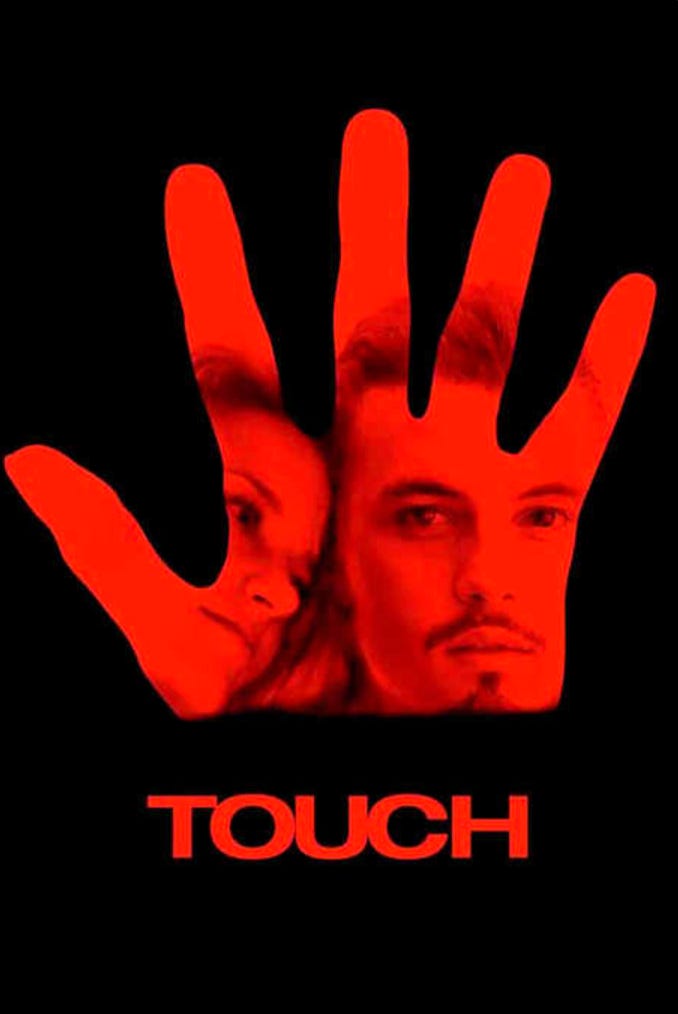
Writer-director Paul Schrader’s adapts Elmore Leonard’s 1987 novel about a detox house worker named Juvenal (Skeet Ulrich) who becomes a sensation when word gets out he has the power to heal with his touch.
Initial Reception
A February dump release (on Valentine’s Day no less), Touch opened on 51 screens on February 14, 1997—and never expanded beyond that. It made $195K opening weekend and its total domestic gross landed somewhere around $400K. Unlike other box office duds of this era, Touch never really found an audience on video or cable either.
Standout Player
Bridget Fonda. Fonda appeared in two Elmore Leonard adaptations in 1997 (this and Quentin Tarantino’s Jackie Brown) and she is lights out in both. Once the story gets going, it’s clear this is her movie and she’s the one you want to see more of—equal parts curious, funny, and sexy.
Key Moment
When we see Juvenal’s stigmata. It’s hinted early in the movie that Juvenal may have healing abilities. But the scene where Fonda’s character, Lynn Faulkner, walks in on Juvenal and sees bleeding crucifixion wounds is where the movie goes to another level. Schrader films it almost like a horror movie.
Killer Line
“Do you think it’s alright? Stigmata blood going in the wash?”
Achilles’ Heal
Tom Arnold. For reasons that remain inexplicable now, there was minute where directors like Schrader and James Cameron were casting Arnold in major roles. It’s clear he’s punching above his weight here. He’s turned up to 11, doing something tonally different from everyone else in the movie.
Why This Movie Still Matters
There was a moment in the 90s following the rise of Tarantino when crime films with colorful characters and dialogue were hot property. Enter Elmore Leonard, the prolific novelist who had been writing books in exactly this style since the late 60s (and served as an inspiration for Tarantino).
While some of Leonard’s crime novels had been made into movies before (1985’s Stick, 1986’s 52 Pick-Up) and so had many of his westerns (1957’s 3:10 to Yuma, 1967’s Hombre), the 90s saw renewed interest in bringing Leonard to the big screen. As a result, we got a trio exceptional Leonard adaptations in quick succession:
Get Shorty (1995) — Director Barry Sonnenfeld nails the comic tone and helps complete the John Travolta comeback story that started with Pulp Fiction. The supporting cast in this is incredible.
Jackie Brown (1997) — Tarantino pays homage to the writer who clearly inspired his work, following up Pulp Fiction with an ode to aging that features an all-star cast (including an electric Bridget Fonda).
Out of Sight (1998) — Director Steven Soderbergh nails this stylistically and gets great lead performances and chemistry from George Clooney and Jennifer Lopez. Probably my favorite of all the Leonard adaptations.
Released around the same time, Touch is not as good as any of those movies. Not even in the same ballpark really. But that doesn’t mean it’s not worthwhile. While it may not live up to expectations of an Elmore Leonard adaptation with the talent involved, it’s still interesting to see how writer-director Paul Schrader approaches the material.
To be sure, the fast and loose style of Leonard is not really Schrader’s bag. This is typically a man with weightier, existential things on his mind. Which is why it sort of makes sense that he would choose this particular Leonard book to adapt—one that includes religious themes (though Schrader claims the religious aspect was purely coincidental, he just liked Leonard’s work).
For a lot of the movie you can see Schrader bumping up against Leonard. He’s trying to make things breezy (including incorporating a score by Dave Grohl). But Schrader’s not breezy by nature; he’s contemplative. As a result, everything just feels a tick off—including the comic and satirical elements, and performances by actors like Christopher Walken and Gina Gershon.
If directing is really just “tone management”, this movie is mismanaged. Schrader acknowledged the film’s discombobulating tone in a 1997 Cinefantastique Magazine interview (which he reposted on Letterboxd)—though he talks about the tone challenges being innate to the material, not necessarily a failing of direction. He stated:
“The problem was the tone, and I suspect that will bedevil the film all through its theatrical and video life. You have healing and stigmata, and on the other hand it’s a comedy and a love story. So, what is it? Please tell us. Make it clear for us. And the film really doesn’t tell you what it is, because it’s all and both.”
The inability for the viewer to find solid footing with Touch is what makes it both interesting and ultimately unfulfilling. It goes to show that, while Leonard’s books seem like almost ready-made films, they’re actually harder to adapt than meets the eye. Turns out, Leonard (and Sonnefeld, Tarantino, and Soderbergh) just make it look easy.
Quick Takes
Though she stopped acting in 2002, Bridget Fonda had an amazing run of movies in the 90s—including The Godfather Part III, Doc Hollywood, Singles, Single White Female, Army of Darkness (cameo), Point of No Return, It Could Happen to You, City Hall, Touch, Jackie Brown, A Simple Plan, and Lake Placid.
In his 1997 Cinefantastique Magazine interview, Schrader notes that the part played by Tom Arnold was originally supposed to be played by Tim Robbins. Without a doubt, replacing Arnold with Robbins would improve the movie.
Elmore Leonard is one of the most adapted modern novelists. 21 film adaptations have been made from his novels and short stories to date (not including 1984’s The Ambassadors, which elmoreleonard.com categorizes as “disowned”, or 1986’s Ruthless People, which borrows heavily from his novel The Switch). Leonard’s “10 Rules of Writing” are a must-read for any writer.
I have the Cinematographe release of Touch. It's such a great gem and Tom Arnold is shockingly good in it.
I saw this a couple years ago during a Schrader binge and just couldn't get on the right wavelength. Like you wrote, the tone is completely baffling. I'm usually down to buy whatever Schrader is selling when it comes to grappling with religion, but it's done better in Hardcore, Master Gardener, and of course First Reformed.