

This post is part of the Get Physical series, exploring movie releases on physical media (typically 4K and Blu-ray).
Release Details
2024 Criterion Collection 4K UHD + Blu-ray Special Edition
From the Back Cover
Home from college, Jeffrey Beaumont (Kyle MacLachlan) makes an unsettling discovery: a severed human ear, lying in a field. In the mystery that follows, by turns terrifying and darkly funny, writer-director David Lynch burrows deep beneath the picturesque surfaces of small-town life.
Package Appeal
Masterpiece. The Blue Velvet Criterion 4K doesn’t break new ground or blow you away with its cover art, but it captures the feel of the movie perfectly. The slipcase recreates the eerie undulating blue velvet of the film’s title sequence, evoking both a sense of mystery and foreboding (it’s like a dark curtain with something hidden behind it).
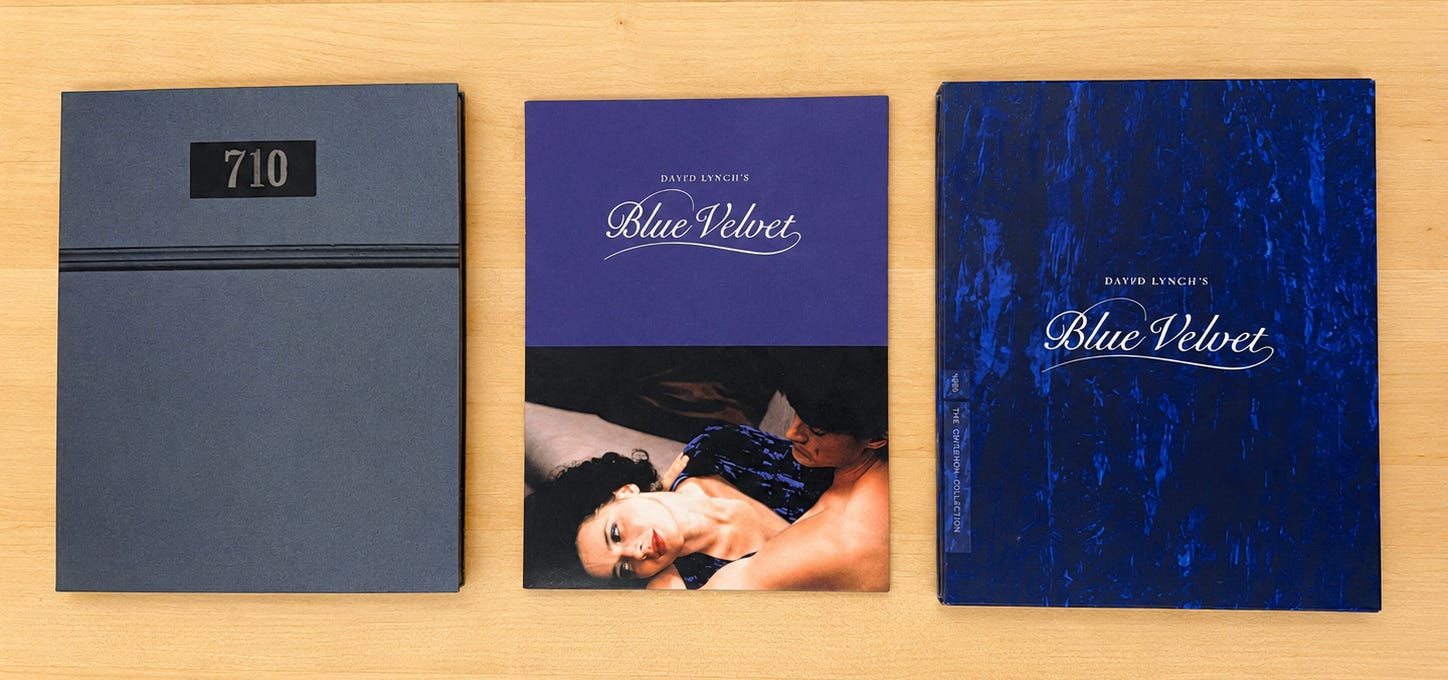
The front of the disc case resembles Dorothy’s grey apartment door (another visual barrier to the secrets contained within). The interior of the case shows the inside of Dorothy’s apartment, while the back shows a robin holding a beetle in its beak. The case also includes a booklet featuring the chapter “A Suburban Romance, Only Different” by Kristine McKenna (excerpted from the book Room to Dream, authored by McKenna and Lynch).
Best Extra
The Lost Footage (53 minutes of deleted scenes and alternate takes assembled by Lynch). This footage is fascinating not just for how much there is but for how complete it is. This is not just rough-cut material, it’s edited and processed (which makes sense since the original version of the film ran nearly four hours long).
We get to see Jeffrey at college; learn about his relationship with his girlfriend, Louise; see more of his house and family (there’s a lot more of his mom and aunt Barbara); get more information about what’s happening with his dad; spend more time with Sandy’s family; and take a longer ride with Frank.
All of this is interesting character building—but none of it adds anything to the movie. It’s a great example of the power of editing and how less can become more (a lesson more directors need to heed today). Blue Velvet is likely a better movie because these scenes exist, allowing the cast and crew more time to inhabit these spaces and explore the characters. But it’s also a movie that’s so much better for what it cut out.
Feature Presentation
Blue Velvet was unleashed in theaters 40 years ago this month. In the decades since, the internet has cracked the world open to a geyser of freaky shit. And still there’s nothing quite like Blue Velvet; nothing that digs so gleefully and horrifyingly into the dark corners of the American dream.
That’s because there’s no one else quite like writer-director David Lynch. Some film fans like to call Blue Velvet “starter Lynch”—an easy entry point to dip you’re toes into his work before diving headfirst into more challenging material like Eraserhead, Lost Highway, or Inland Empire.
For my money, Blue Velvet is not just a good Lynch starting point; it’s his best movie (and I like every movie he’s made). A big reason for that is because it’s tethered to traditional storytelling (playing on our expectations of it, really). Lynch still has one foot in a conventional movie narrative here.
Lynch is at his best when he keeps things a little more grounded (or at least grounded in the plot mechanics of popular fiction)—as he does with this, early Twin Peaks, Wild at Heart, and Mulholland Drive. The madness, darkness, and surrealism are much more striking when they sneak up on you rather than when you’re immersed in them.
Leading up to Blue Velvet, Lynch had made three full-length features:
Eraserhead (1977): A grab-your-attention midnight movie
The Elephant Man (1980): A prestigious, step-up-to-the-big-leagues gig that scored Best Picture and Best Director Oscar nominations
Dune (1984): A high-profile, big-budget sci-fi flop that nearly derailed his career
Those stepping stones are crucial to what he does with Blue Velvet—scaling back and getting more personal, but without completely abandoning his commercial sensibilities. He creates something quirky and unique (unlike any other director—or writer—would concoct), while showing how technically adept and in control of the medium he is.
From the slow pan inside the severed ear to Laura Dern stepping out the darkness to Dorothy Valens singing at the Slow Club, there are numerous showstopping shots in Blue Velvet. And how about the transition from the coroner talking about the ear being cut off with scissors to a shot of scissors cutting police tape? Or Frank disappearing in a blink to the sound of screeching tires? These are bold editing strokes that work.
There’s also the production design of Dorothy’s apartment. The mesmerizing (and often terrifying) use of sound. The integration of pop music. And the performances (many of them career peaks for the actors). All these elements are employed for maximum effectiveness. Because Lynch is so often showing us unusual things on screen, it’s easy to miss what a fantastic director he is. This guy just had it.
Blue Velvet might also be where his writing and directing gel together the best. The way he lays out the thematic idea in the opening scene and then progressively takes viewers deeper and deeper down the rabbit hole is masterful.
In the first 10 minutes, we get the discovery of the ear, opening up the mystery to Jeffrey and Sandy (and us). Then, 30 minutes in, we get the introduction of Dorothy, which takes us to a different, more disturbing place. Then, at the 45 minute mark, we’re introduced to Frank Booth (the scariest movie villain of all time) and suddenly the ground drops out beneath us.
This culminates with what might be my favorite moment in all of cinema, when Jeffrey meets Frank face-to-face for the first time in the hallway of Dorothy’s apartment:
What transpires after that can only be described as a road trip into hell. Hilarious and unsettling, Lynch takes us from the safety of the suburbs to the underworld right next door. It’s one of those rare moments in a movie when you legitimately have no idea what’s going to happen next (and this is true no matter how many times you watch it).
As a child of the 1980s, not a lot of content was off limits to me. I grew up in an HBO house. I saw Woody Allen movies and Bonnie and Clyde before I was a pre-teen. But when I walked into the room when my parents were watching Blue Velvet, that was one of the rare times I was instructed to stay away. This was not a movie for children.
I had probably seen worse things at that point (more gratuitous things anyway). But something about this movie was different. Inside our suburban home, with the green lawn out front, Blue Velvet was best kept hidden in the dark.
Quick Takes
Siskel and Ebert had one of their most famous splits over Blue Velvet. Siskel named it one of the best movies of the year, saying: “This did for me what Psycho did, which is ‘Oh my god, we’re really getting in over our heads.’ And that’s an experience, which is challenging, shocking, but mesmerizing.” Ebert, on the other hand (or thumb), hated the movie, saying: “I think this movie is cruelly unfair to its actors. It was directed by David Lynch, the same man who made Eraserhead and Dune, and he’s a talented director—you can see that here in scenes that have a lot of power. But he asks Isabella Rossellini in this movie to be undressed and humiliated on the screen as few actresses ever have been, certainly in non-porno roles. Then he tries to take the edge off her scenes by turning the whole thing into a joke.” You can watch their full review here.
In the early 1980s, Dennis Hopper’s life and career were in rough shape. While he was still getting work in movies like Rumble Fish and The Osterman Weekend, his drinking and drug use were spinning out of control. He told Cigar Aficionado in 2001, “My last five years of drinking was a nightmare. I was drinking a half-gallon of rum with a fifth of rum on the side in case I ran out, 28 beers a day, and three grams of cocaine just to keep me moving around. And I thought I was doing fine because I wasn’t crawling around drunk on the floor.” After finally getting sober in 1983, Hopper didn’t know if he would be able to act anymore—and then he ripped off a trio of career-best performances in Blue Velvet, Hoosiers, and River’s Edge. He received a Best Supporting Actor nomination for Hoosiers (a worthy nomination—though he should’ve been nominated and won for Blue Velvet).
After Lynch passed away in January 2025, The Guardian published this article where fellow directors shared memories of the legendary director. Among them was a blurb from writer-director Paul Schrader, who noted his contribution to Blue Velvet. Schrader states: “David couldn’t get Blue Velvet made. Dino De Laurentiis told David he’d pay me to rewrite the script and David gave it to me. It was one of the best scripts I’d ever read. I told Dino there was no way I could improve it. David thanked me and Dino financed the film. The rest is film history.”