

This post is part of the Get Physical series, exploring movie releases on physical media (typically 4K and Blu-ray).
Release Details
2017 Sony Pictures Home Entertainment 40th Anniversary 3-disc 4K UHD Blu-ray Edition
From the Back Cover
Richard Dreyfuss stars as cable worker Roy neary, who experiences a close encounter of the first kind—witnessing UFOs soaring across the sky. Meanwhile, government agents have close encounters of the second kind—discovering physical evidence of extraterrestrial visitors in the form of a lost fighter aircraft from World War II and a stranded military ship that disappeared decades earlier only to suddenly reappear in an unusual place. Roy and the agents follow the clues that have drawn them to reach a site where they will have a close encounter of the third kind—contact.
Package Appeal
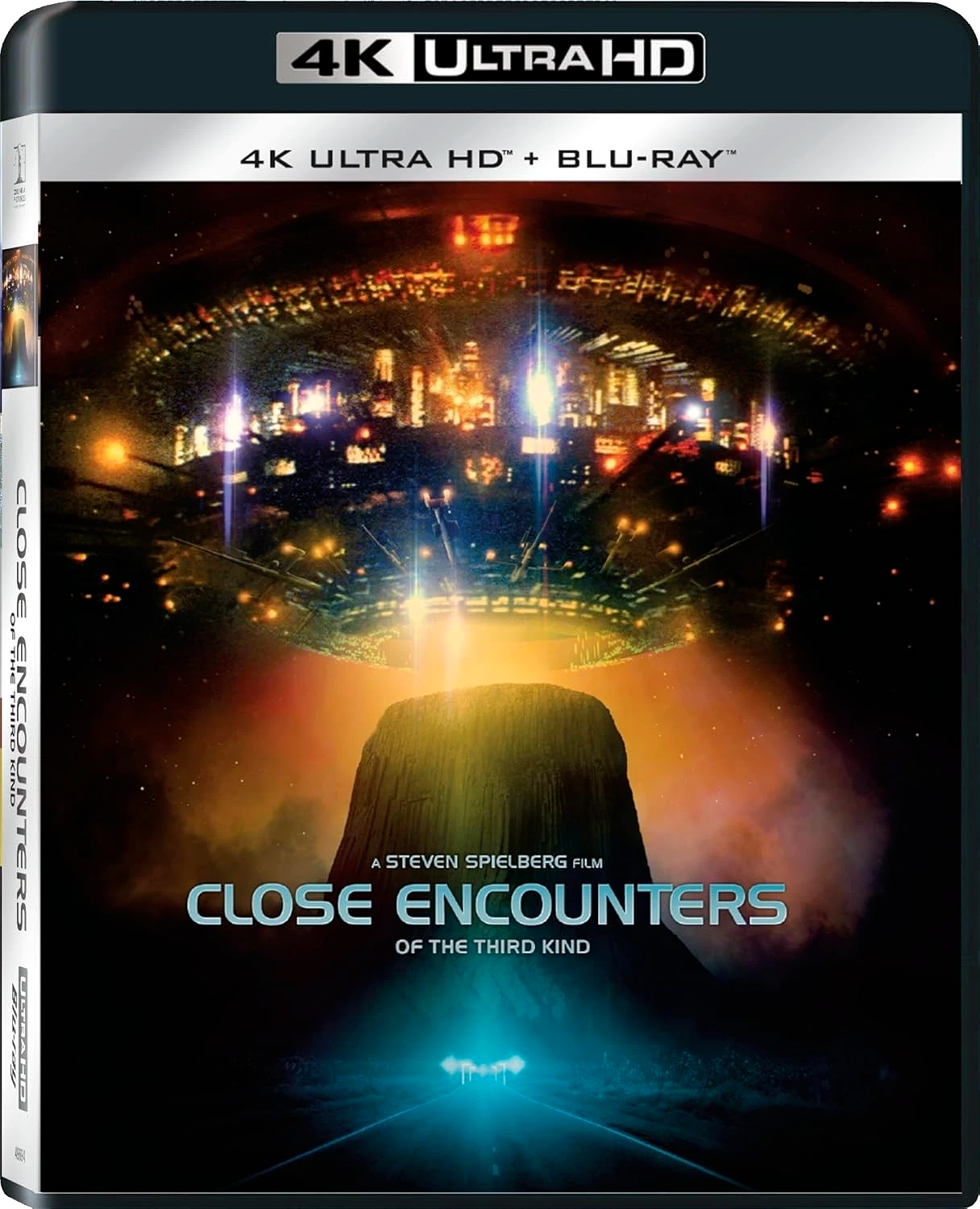
The cover image uses the 40th anniversary theatrical rerelease poster, showing the movie’s meticulously designed alien spacecraft hovering over Devil’s Canyon. It’s a striking image. Other than that, this edition (the non-gift set version) is bare bones—with no inserts or disc art (a little disappointing for an anniversary edition).
Best Extra
The home run here is that this edition includes all three versions of the film: the 1977 135-minute theatrical release, the 1980 132-minute “Special Edition,” and the 1998 137-minute “Director’s Cut.”
People have different opinions on which version’s the best. But generally the theatrical and director’s cut are considered the superior versions, with writer-director Steven Spielberg himself saying he prefers the director’s cut.
Feature Presentation
Sometimes the only way to break out of suburban malaise—to escape from nights crammed together in a cluttered home debating whether the next family adventure will be a trip to see Pinocchio or a game of Goofy Golf—is to encounter something from another world.
After Roy Neary (Richard Dreyfuss, at his peak here) comes in contact with a UFO one night (well, actually, multiple UFOs), his mundane life is suddenly cracked open. All he can think about is what else might be out there. Goofy Golf will have to wait.
For all the impressive effects, the epic scope, and the overall blockbuster spectacle, it’s inside the home where Close Encounters really comes alive. This is where many of the most memorable and affecting parts of the movie take place.
As Roy tries to make sense of what he’s seen, and becomes oddly obsessed with a vision in his head he just can’t shake, his wife, Ronnie (Teri Garr), and three kids at first take it in stride (“Don’t you think I’m taking this really well?” Ronnie asks after he drags her and the kids out of bed to stare at the sky). But things escalate quickly, and soon Roy’s going gonzo on the mashed potatoes.
Garr (always great) gives an underrated performance here as a woman whose life is thrown completely out of whack by something literally dropping out of the sky (or maybe it wasn’t really that stable to begin with?). Her response to a manic Roy telling her “you’re not even dressed, you look crazy” as she’s making her escape from him with the kids is note-perfect.
For a movie that includes the discovery of a missing merchant ship in the desert, an elaborate vision of first contact, and famed French director Francois Truffaut in a key role, it’s these close-to-home moments that stick the most.
Quick Takes
J.J. Abrams notes in Three Kinds of Close Encounters featurette that both Star Wars and Close Encounters of the Third Kind were released in the same year—1977—and if you were a person like him, you weren’t the same after that one-two punch (Star Wars came out at the end of May, Close Encounters hit theaters in mid-November). George Lucas famously bet Steven Spielberg that Close Encounters would do better at the box office, with the winner getting some of the other person’s box-office percentage points. Spielberg won, earning a chunk of Star Wars that reportedly netted him over $40 million.
While it was no Star Wars (which earned $307 million domestic upon initial release), Close Encounters was no slouch at the box office itself—raking in more than $113 million at the domestic box office in its original release (that’s $628 million in today’s dollars). It was also nominated for eight Academy Awards, winning two (for cinematography and sound editing) and earning Spielberg his first Best Director nomination.
On a recent episode of The Rewatchables podcast discussing 2001: A Space Odyssey, Spielberg was a guest. The director provided a little offhand insight into how they did some of the effects on Close Encounters. He shared (paraphrasing): “We had a cloud tank that made very realistic clouds. Paint was jetted into the water with great force, which creates cumulus clouds. And we had lights behind it. And when we photographed that in 65mm, and then projected that on our front projection material, it made it look like they were really outside during a distant electrical storm.”
Spielberg wrote the part of Claude Lacombe specifically for Truffaut, the legendary director who helped kickstart the French New Wave with films like The 400 Blows, Shoot the Piano Player, and Jules and Jim. Though Spielberg was nervous to ask him, Truffaut agreed to take the part—the only English-speaking acting role of his career and one of his few onscreen appearances outside of films he directed.