

This post is part of the Get Physical series, exploring movie releases on physical media (typically 4K and Blu-ray).
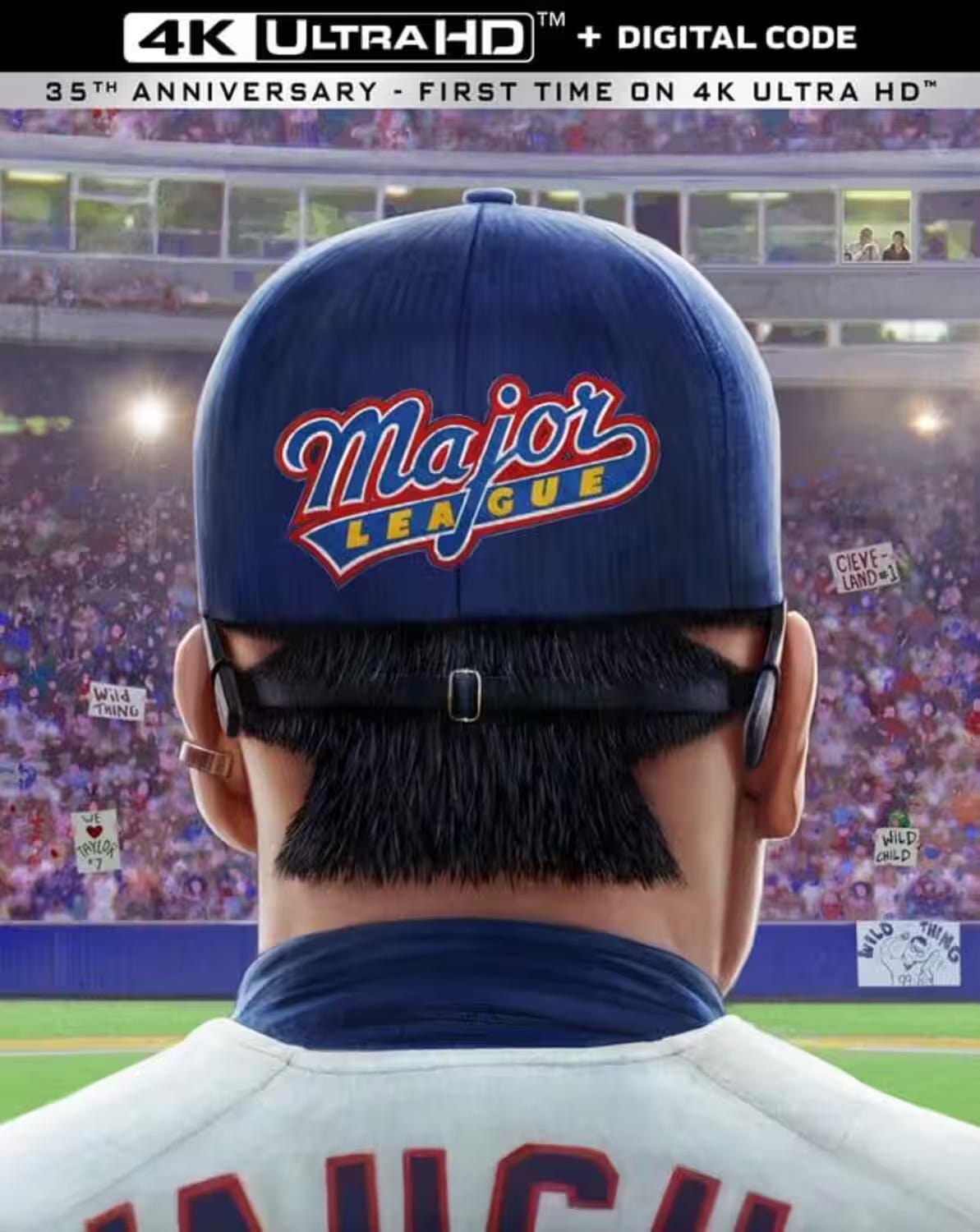
Release Details
2024 35th Anniversary Edition 4K UHD Blu-ray from Paramount Home Entertainment
From the Back Cover
They’re the wildest gang of screwballs that ever spit tobacco—a handsome, but hopeless assembly of baseball-playing misfits set up to fail by their scheming new owner. Once they strike-out all season, she’ll move the team from Cleveland to Miami.
Package Appeal
Solid: While the Paramount packaging is pretty much by the numbers, I do give them credit for the cover design—which is new to this release and nods to one of the most electric moments (and characters) in the movie.
Best Extra
Alternate Ending with Filmmaker Introduction: This is not actually an “ending” at all, but rather a surprise twist that would have come near the end of the film. The twist? Margaret Whitton’s evil owner Rachel Phelps is not evil at all but rather an incredibly savvy, baseball-loving businesswoman who handpicked the players for their unique talents and concocted the moving-the-team scheme to inspire them to win. The twist tested well, but audiences were having so much fun rooting against Rachel as the villain they decided to cut it.
Feature Presentation
Major League is the kind of movie that probably wouldn’t get made today. It’s hard to fathom any Major League Baseball (MLB) team (or the league itself) going for this kind of depiction of the team, ownership, or the sport.
That’s a bummer because the down-and-dirty dustiness of the Cleveland Indians (now known as the Guardians) portrayed here is what makes this movie so good. These are not polished players living with PR teams and personal trainers; these are scrappers struggling to make or stay in the league.
The same goes for the city of Cleveland, which is introduced in the opening credits through shots of dilapidated factories exhausting massive billows of smoke. I love a city with a personality in a movie. And this one’s got a down-on-its-luck Cleveland (is there another kind?) filled with working-class people doing working-class jobs, resigned to the fact their team is never gonna win.
Enter into that atmosphere a pack of lovable losers sent (unbeknownst to them) on a mission to continue losing. By making the team so bad they can’t possibly compete, Whitton’s owner plans to hit new attendance lows—triggering a clause that will allow her to relocate the team to a warmer climate. Whitton is great as villain with a clear and simple goal: get the f**k out of Cleveland.
Equally great is the rest of the cast. Echoing their characters, we get actors at different phases of their careers:
Tom Berenger, who got some shots but never quite made it as a leading man, plays the journeyman catcher on his last legs.
Charlie Sheen and Wesley Snipes, both on their way to bigger stardom at the time, play the young upstarts.
Corbin Bersen, who was a huge TV star with L.A. Law, plays the talented guy coasting on his laurels.
Dennis Haysbert, who would go on to play the president on 24 and appear in countless Allstate ads, is the talented power hitter whose game hasn’t come together.
James Gammon, who played a lot of cowboys and had one of the gruffest voices of all time, plays the manager pulled out of his job at a tire repair shop.
Rene Russo, appearing in her very first movie, is Berenger’s love interest. She would go on to play the love interest in every studio movie made for the next 10 years.
Bob Eucker—who steals every scene he’s in as announcer Harry Doyle—was an actual announcer for the Milwaukee Brewers (and a former MLB player). Eucker was also appearing on the NBC sitcom Mr. Belvedere at the time (where he also played a sportscaster).
It’s a loaded lineup, and they get every ounce (and more) from writer-director David S. Ward’s solid script—which has a great comic premise but also never really treats itself like a comedy. That enables the movie to both be funny as hell while having air of romance and melancholy.
As a result, we can laugh at Sheen’s zig-zag haircut, his wild pitches, and Snipes’ reaction to seeing him wearing thick glasses for the first time. But when his character comes out of the bullpen during the team’s climactic game, with the crowd exuberantly singing “Wild Thing”, we can also be on our feet, radiating the sheer joy of baseball and cinema.
Quick Takes
Major League writer-director David S. Ward had an interesting career. In 1974, he won an Academy Award at the young age of 28 for Best Original Screenplay for The Sting. He went on to write and direct Major League and its sequel 1994’s Major League 2: Back to the Minors, 1991’s King Ralph with John Goodman, and the 1993 college football movie The Program with James Caan. He also co-wrote 1993’s Sleepless in Seattle with Nora Ephron and Jeff Arch (for which he received another Oscar nomination). He said his inspiration for Major League came from being a long-suffering Cleveland Indians fan.
I called this a top 5 sports comedy. So what other four movies make the list? While I don’t a full list ironed out, I’d say the other four slots are between Slap Shot, The Bad News Bears, Happy Gilmore, White Men Can’t Jump, Kingpin, and A League of Their Own. I’m sure many people would undoubtedly add Bull Durham, The Longest Yard (1974), and Caddyshack to that list—but those are all movies I like more than love.
I saw Major League for the first time when I was around 10 or 11 years old. I immediately started ripping sleeves off my shirts. That’s how powerful a character Rick “Wild Thing” Vaugh is. He’s up there with Han Solo, Conan the Barbarian, and Marty McFly for me in terms of movie characters I just wanted to be.
Hot take: I’m not sure the Indians should win at the end. I don’t know if the team losing necessarily fits the tone of the movie, or if it’s fair to a city that always feels like it comes up short, but Cleveland winning just feels like a fantasy here. A Rocky ending might have been more appropriate: They lose the game but the team gets to stay in the city (a moral victory).