

This post is part of the Get Physical series, exploring movie releases on physical media (typically 4K and Blu-ray).
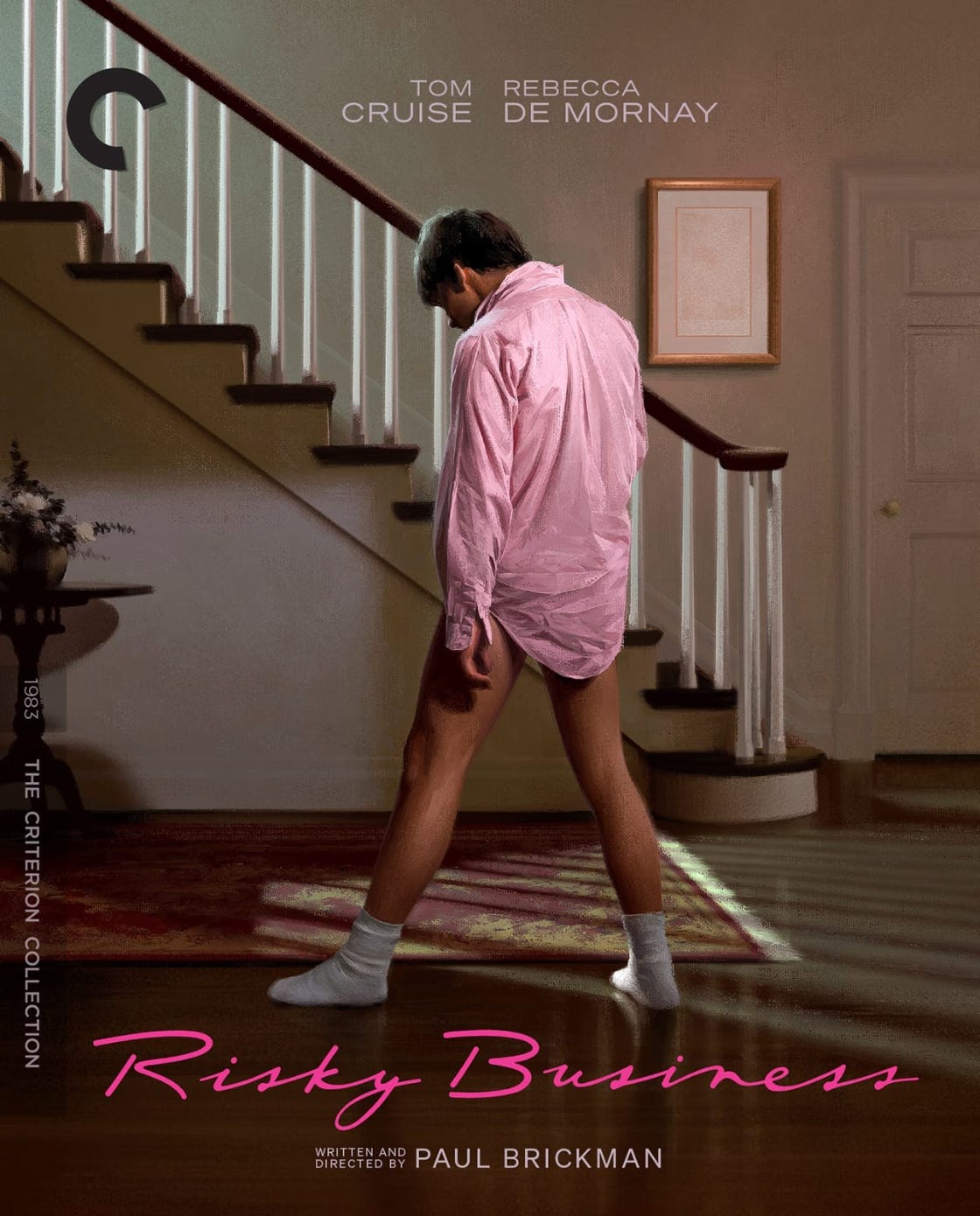
The hit 1983 comedy-drama stars Tom Cruise as a suburban teen and Rebecca De Mornay as a lady of the night who teaches him lessons about sex and economics.
What’s In The Box?
This is the Criterion Collection “director-approved” 4K UHD + Blu-ray Special Edition of the movie. It includes both the original and director’s cut of the movie in 4K Dolby Vision HDR with 5.1 surround.
Cover Appeal
The new cover illustration by Jeremy Enecio captures the movie’s most iconic moment—Tom Cruise dancing in a dress shirt and tighty whities to Bob Seger’s “Old Time Rock N’ Roll”. I like the coloration and how they captured this—with Cruise’s face turned away—but I can’t help but feel they should’ve done something more creative. This one is just a little too on-the-nose.
Best Extra
There’s several new features with this release—including interviews with producer Jon Avnet, casting director Nancy Klopper, and editor Richard Chew. But my favorite features still come from previous releases. One is the half-hour “The Dream Is Always the Same” making-of program that includes interviews with all the key players, as well as people like Cameron Crowe and Peter Travers. The other is the original screen tests with Cruise and De Mornay. Seeing these two young, hungry actors on videotape is like being teleported back in time.
Big Picture
“Listen to you guys. Doesn’t anyone want to accomplish anything or do we just want to make money?”
Joel, a high-school senior, poses this question to a group of friends at a local restaurant. A moment passes. The group looks around at each other. Then they smile and all agree “just make money”. Joel laughs and plays it off as a joke. But you can tell from the look in his eyes he’s not so sure.
The scene is a blip in the movie. It comes about 12 minutes in, lasts less than a minute, and then we are on with the story. But it tells us everything we need to know about Joel and where his head’s at versus the materialistic world around him.
As played by a soft-spoken, pre-cocky Cruise, it’s easy to like Joel. He’s our hero, a young man in over his head, anxious about the world in front of him. We largely see the world through his POV—one early tracking shot literally lets us see his house and parents completely through his eyes—and we want him both to have a good time and not get into too much trouble. We want to see him succeed.
All credit goes to writer-director Paul Brickman, who smartly and subtly gives us The Graduate in Porky’s clothing here. And just as Mike Nichols did with The Graduate, Brickman does a sly job of aligning us with the young protagonist—even though much of what we see is likely bullshit (or at least heavily hazed by youth).
Take the scene where Joel first encounters De Mornay’s Lana. It’s dreamlike, with Lana strolling into Joel’s house, the wind blowing the doors open, and the two making love in multiple places and multiple ways all night long. Are we really to believe this is how sex would go down with a horny, hard-up teenager?
Then there’s the scene where Joel’s father’s Porsche slides into the lake. Switching between an inside-the-car-looking-out perspective shot and a shaky handheld side view, it feels like a horror movie. Which is what it is to Joel.
The brilliance of Brickman’s direction (aided by the intense, moody Tangerine Dream score) is not only does it frequently blur fantasy and reality, but it also gets us to buy into the idea that the stakes are super high for Joel. When, in reality, the stakes couldn’t be lower.
Whether Joel, an upper middle class Michigan white boy, gets into an elite college might matter to him and his family, but he’ll probably be fine if he goes to University of Illinois. And if Joel’s dad’s Porsche is destroyed or his mom’s prized crystal egg is stolen? Sure, they’ll be mad. But these are luxury items for people who can afford to own luxury items (and to head off on vacation for a week).
Only Lana sees things as they truly are. She knows Joel’s problems don’t really amount to a hill of beans, which is why from the moment she walks on screen (in one of the great “sweet goddam” moments of the 1980s) she immediately goes to work extorting him.
Like Cruise, DeMornay is so attractive and likable you want to go along with her, even if her motivations aren’t always pure. Or maybe they are? At least Lana never pretends to be something she isn’t. She doesn’t have the luxury of thinking about the downside of capitalism.
Lana knows what we don’t—what Cruise’s performance and Brickman’s filmmaking help us overlook. That when you step back and think about where Joel comes from and who he’ll likely grow up to be, no matter how this particular story plays out, the future is actually pretty certain for him.
He’ll grow up, purchase a home, sports car, and his own version of the crystal egg (bigger, better, and more expensive), and breed his own future money-makers. At best, he’s probably just another rich asshole. At worst, he might become something more toxic or sinister (perhaps with ties to Epstein or today’s administration).
And the high-school Joel from that restaurant table, sitting around with friends luxuriating in their youth, the faint glimmer of idealism still sparkling in the corner of his eye, will be just an occasional lost memory that he has to shake off with a couple stiff drinks; pretending it was all just a dream.
Quick Takes
Writer-director Paul Brickman is a curious case. He had Hollywood in the palm of his hands after the success of Risky Business (it was the eighth highest grossing movie at the U.S. box office in 1983, bringing in $63 million on a reported $6 million budget). But Brickman, soured by the changing of the original ending of Risky Business (more on this below), didn’t want it. Though he has mentioned in interviews that he received plenty of offers and was floated scripts like Rain Man and Forest Gump, he wouldn’t direct another film until 1990’s Men Don’t Leave. After that, he would never direct another feature film again.
The director’s cut for Risky Business is interesting because there is only a single change: the ending. In the theatrical cut, we see Joel and Lana walking through a park sharing some playful banter. Then Joel’s voiceover ends with the line “Time of your life, huh, kid?” In the director’s cut, we stay with Joel and Lana in the restaurant. Joel calls Lana over to sit with him (Brickman noted this as a shift in the power dynamic). We end on him holding her with the last line of Joel’s voiceover now saying “Isn’t life grand?” While these changes are relatively small (maybe 30 seconds of different footage), they alter the tone we fade to black on and what we walk away thinking about (which is everything).
Rebecca De Mornay says in the “The Dream Is Always the Same” that she didn’t have a single screen credit before Risky Business (not on TV or in movies). The fact that her first film was a smash should have set her up for a big career. But it didn’t quite pan out that way. Her next movie Testament (released only a few months after Risky Business) barely played in theaters, grossing just over $2 million. Her true follow up didn’t come until 1985 with The Slugger’s Wife. That movie was both panned by critics and DOA at the box office (earning less than $2 million). Though she did some interesting work over the years, she wouldn’t have another real hit again until the early 90s with Backdraft (where she played a supporting role) and The Hand That Rocks the Cradle (which helped revive her career).
a pivotal film for me, my dad and I stumbled upon it one late night and it was one of the most awkward watches ever since I was 9 at the time.