

This post is part of the Modern Classics series, spotlighting movies released since 2000 that have already earned a place among the all-time greats.
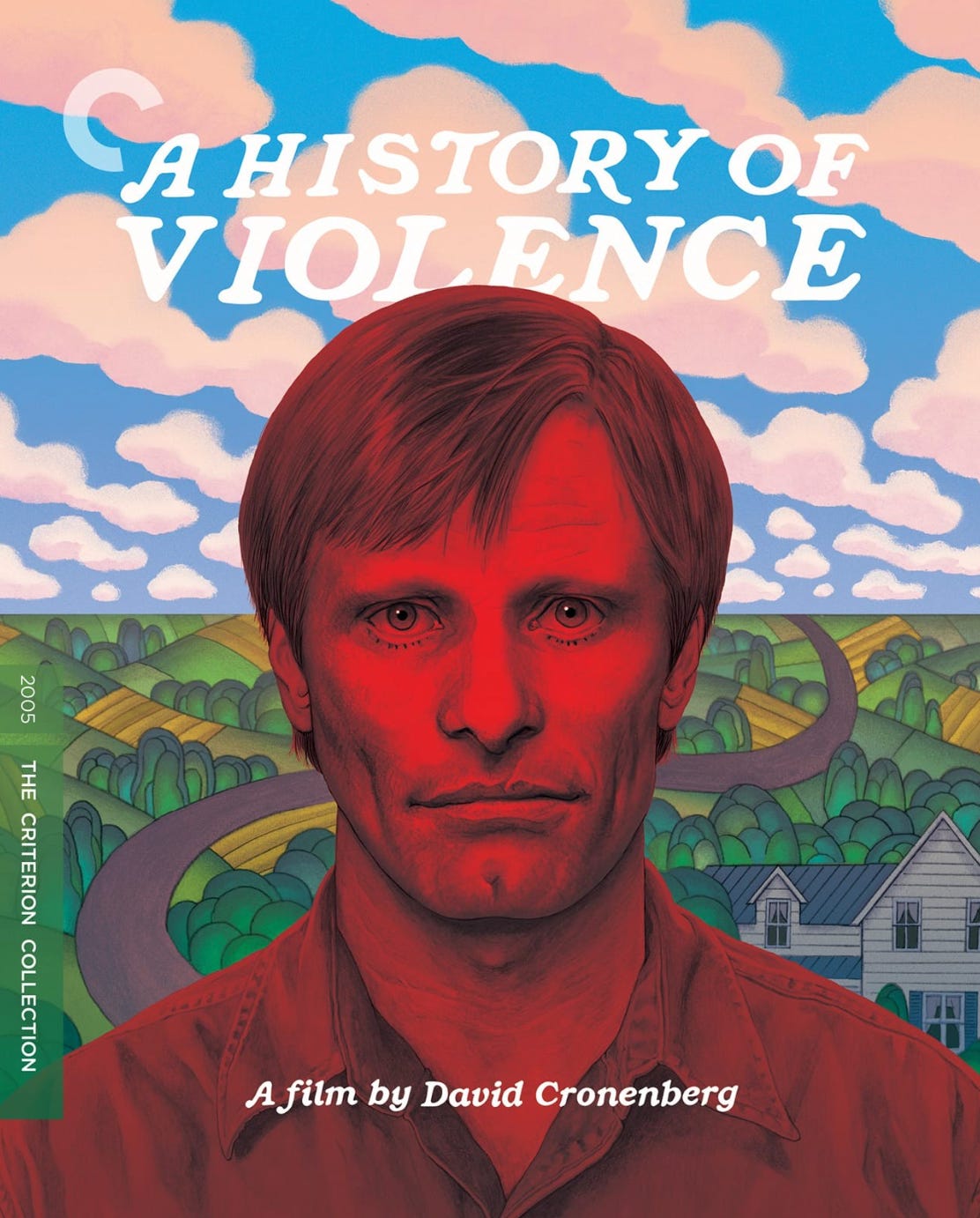
When diner owner Tom Stall (Viggo Mortensen) stops a violent crime, it brings trouble to his small town and unlocks another side of him that makes his family question who he really is.
Initial Reception
Released in September 2005 (in the wake of Hurricane Katrina), A History of Violence was greeted with near-universal critical praise. While not a box office smash, it would hang in theaters for close to two months, legging out to $31 million domestic and $61 million worldwide (making it director David Cronenberg’s most successful film). The movie would also earn two Academy Award nominations: Best Supporting Actor (William Hurt) and Best Adapted Screenplay (Josh Olson).
Key Moment
The showdown in the Stall’s front yard. Coming at the start of the movie’s third act, Tom finally faces down the mysterious stranger (played by Ed Harris) and his thugs who have been harassing him. It’s an intense moment that leads to us seeing Tom in a different light, climaxing with some wince-inducing Cronenbergian violence.
Killer Line
“I should’ve killed you back in Philly.”
Standout Player
Stephan Dupuis, the makeup supervisor. There are a number of disturbing images in the film that Dupuis brings to life—including Harris’s facial scars and milky eye; a man’s jaw hanging off after he’s shot at point-blank range; and a brutally smashed nose with crushed cartilage and bone peeking out.
Achilles’ Heal
There’s no notable weakness here—though the resemblance between Ashton Holmes (who plays Tom’s son, Jack) and Jesse Eisenberg can be slightly distracting.
Why It’s a Classic
The secret sauce of A History of Violence’s is its surface simplicity. This is a movie that doesn’t get caught up in a lot of narrative complexity. A man stops some thugs from robbing his diner by killing them. Then some more bad guys come to town looking for him. Then he must confront the source of those bad guys.
Director David Cronenberg and screenwriter Josh Olson move us clearly from points A to B to C so they can focus on digging deeper into theme and character. They don’t get sidetracked or feel the need to hammer the same nails over and over (the movie clocks in at a lean 96 minutes).
While considered more mainstream fare from Cronenberg—whose films leading up to this included more challenging material like Spider, eXistenZ, Crash, and Naked Lunch—A History of Violence isn’t as far outside the director’s typical body horror wheelhouse as it might seem. As in movies like Rabid, Videodrome, and The Fly, exposure to an outside influence leads to internal transformation. Here that influence is violence and, once it takes root, it spreads and infects everything around it.
In a making-of documentary on the Criterion 4K Special Edition, Olson notes that Cronenberg didn’t storyboard scenes or rehearse with actors until he got on set. This approach, combined with the tight thematic focus of the story, brings out the best in nearly every actor in the movie.
As the lead, Mortensen—an actor I’ve always found a bit cold and stiff—is dead on here, nailing Tom’s quiet soft-spokenness while also hinting at something darker simmering below the surface. He switches subtly between facades, never resorting to playing nebbish in the film’s early scenes or going over the top in the later ones (a route I think a less intelligent actor-director combo might have chosen).
As Tom’s wife, Edie, Maria Bello might give my favorite performance in the movie. She takes what could be a thankless role and gives her realism and resolve, bringing something new to almost every scene. This is a woman trying to both piece it together and hold her family together. Her conflicted stairwell sex scene with Mortensen is one of the movie’s surprising highlights.
And Harris and Hurt both bite into the material with relish, bringing something akin to fun to a mostly heavy movie. While Hurt scored the Oscar nom, I actually like what Harris is doing a little more—delivering calm and patient menace behind a half-disfigured grinning face. The fact that this guy doesn’t have a supporting actor Oscar is beyond criminal.
All of these actors create memorable characters triggered into crisis and action by a sudden act of violence that bleeds into their lives. It’s a timeless tale (it could have been set 50 years ago or yesterday) that Cronenberg and crew execute in a way that lingers like the sustained image of a gushing gunshot wound on a dead man’s face.
Quick Takes
A History of Violence is based on a 1997 graphic novel of the same name by writer John Wagner and illustrator Vince Locke (hence the “adapted” screenplay Oscar nomination). This makes it a “comic-book movie”—though like Ghost World and Road to Perdition it’s not generally thought of in this way.
The Criterion 4K for A History of Violence (released in October 2025) contains a deleted nightmare sequence where Tom shoots Harris’s character with a shotgun—blowing his chest wide open and creating a smoking, gaping hole—before Harris shoots him. Cronenberg notes in his commentary that people would think it’s the type of scene he would want or even demand in the movie but it just didn’t work.
Mortensen would collaborate with Croneberg on his next two movies: 2007’s Eastern Promises (where he has a knife fight with his dong out) and 2011’s A Dangerous Method (where he plays Sigmund Freud). Mortensen would receive the first of his three Best Actor nominations for Eastern Promises. Despite making 23 movies (and counting!), Cronenberg has never been nominated for an Oscar.
Criminally underrated Cronenberg. Functions as a modern western, nice write up.
The way Ed Harris chews into the name "Joey" makes my skin crawl. I think there's something to the naming there -- "TOM STALL" is such a sturdy, straightforward American name, easy to pronounce, you don't have to move your lips much. But "JOEY CUSACK", you really have to roll the tongue, the "o" and the "u" have to be pronounced out loud, it feels twistier, more slippery. I think you can tell Ed Harris got that.