

This post is part of the Modern Classics series, spotlighting movies released since 2000 that have already earned a place among the all-time greats.
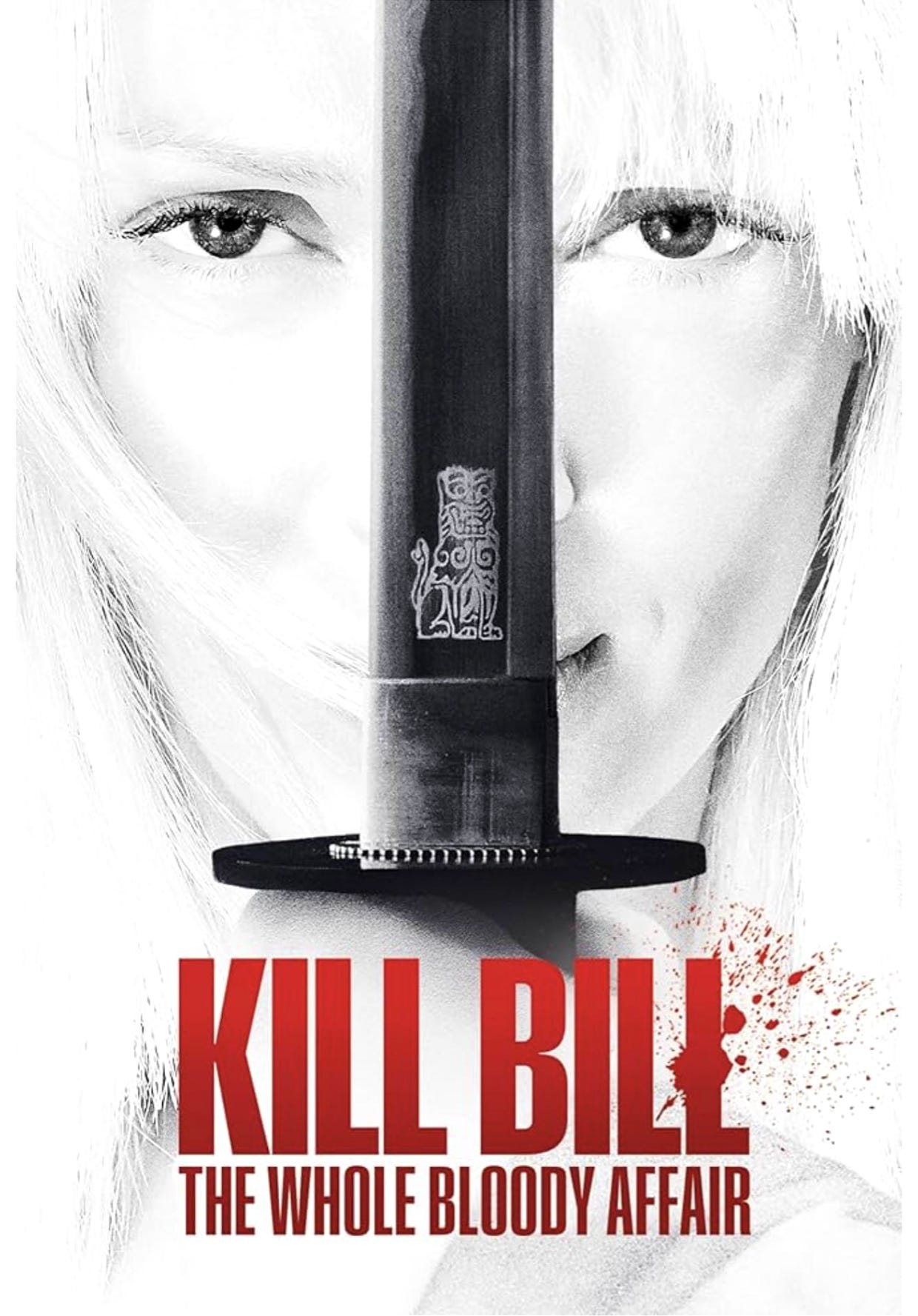
After her former team, the Deadly Viper Assassination Squad, led by her one-time paramour Bill (David Carradine), attempts to murder her on her wedding day, “The Bride” (Uma Thurman) sets out for bloody revenge.
Initial Reception
When the original cut ran too long to be released as a single movie, director Quentin Tarantino and then-Miramax-co-chairman Harvey Weinstein made the decision to chop Kill Bill in two.
The first movie, released in October 2003 as Kill Bill: Volume 1, was a hit, earning $70M at the domestic box office and $180M worldwide. Roger Ebert gave the film four stars, writing: “‘Kill Bill, Volume 1’ shows Quentin Tarantino so effortlessly and brilliantly in command of his technique that he reminds me of a virtuoso violinist racing through ‘Flight of the Bumble Bee’.”
Released six months later in April 2004, Kill Bill: Volume 2 earned another $66M domestic and $152M worldwide—and another four-star review from Ebert (“I liked it even more than ‘Kill Bill, Volume 1’.”).
As noted in this post, shamefully neither Kill Bill movie received a single Academy Award nomination.
Key Moment
There are so many memorable moments throughout the four-hour-plus duration of Kill Bill. But the key moment, THE moment really, is the House of the Blue Leaves fight sequence—an insane, chaotic, bloody ballet where The Bride takes on the Crazy 88, O-Ren Ishii’s yakuza army, in a Japan restaurant. This wild, inventive, and kinetic 20-minute barrage of non-stop attacks and hacked limbs might be the most impressive thing Tarantino has ever put on film (and that’s saying something). It also includes the amazing Go Go Yubari.
Killer Line
“If on your journey you should encounter god, god will be cut.”
Standout Player
I’m gonna whittle it down to five nominees (presented in alphabetical order):
Michael Madsen — This is Madsen’s best movie performance. Whether he’s taking shit from a strip club owner or pulling one over on The Bride, he’s cloaked in a defeated weariness that gives his character a depth beyond all the other baddies (even Bill).
Sally Menke — Menke, a two-time Academy Award nominee for Best Editing (for Pulp Fiction and Inglourious Basterds) does her career-best work here—a tour-de-force that requires her to both match the rhythms of different film genres (sometimes simultaneously) and make it feel modern.
RZA — A big part of what makes Kill Bill such a roller-coaster ride is the music. RZA’s score is doing so many different things from moment to moment, nodding to kung fu movies past while creating something original and unforgettable. He takes us to the perfect place as we stare into The Bride’s fiery eyes.
Quentin Tarantino — This might not be the best screenplay Tarantino’s ever written (though, to be fair, that’s a VERY high bar). But it might be his best directed movie. Tarantino throws the kitchen sink at this thing, along with dozens (if not hundreds) of the movies that made him, to bring it to life.
Uma Thurman — I wouldn’t necessarily count Uma as one of my favorite actresses. But she’s incredible here. Whether she’s waking up after four years in a coma, fighting 50 yakuza members, or being buried alive, you always feel her pain. I’m not sure who else could have pulled off both the physicality and emotion of this part.
For me, this comes down to Menke and RZA. I don’t know that this movie works without either one of them. But RZA really brings something special, so let’s hand him the trophy.
Achilles’ Heal
This might be an unpopular opinion, but, for me, it’s Carradine as the titular Bill. Don’t get me wrong, he’s not bad. I’ve just never felt he had enough of the weight or gravitas the character required. This is someone who is built up throughout the entire movie (or two movies). He should be larger than life. While Carradine brings the Kung Fu connection, he doesn’t bring that total intimidation factor.
Or maybe the Achilles’ Heal is actually just the final Bill-Bride encounter. I almost never say this about Tarantino, but I think this scene is overwritten. If it was trimmed by a monologue or two, would Carradine’s performance work better for me? It’s very possible.
Why It’s a Classic
Every Quentin Tarantino movie is inherently about movies. The movies that leave an imprint, how they exist in our minds, and the role they play in our lives. But Kill Bill might be the Tarantino movie that’s the MOST about movies. And the most Tarantino too.
Appearing on “The Church of Tarantino” podcast in August 2025, Tarantino stated: “I think Kill Bill is the ultimate Quentin movie. Like nobody else could have made it. Every aspect about it is particularly ripped, like with tentacles and bloody tissue, from my imagination and my id and my loves and my passions and my obsessions. I think Kill Bill is the movie I was born to make.”
The movie is set up in chapters. And almost every chapter is like the best part of a movie you once saw at the drive-in or watched on VHS or caught on cable; the part that made the whole movie worthwhile. It’s an original album that plays like a greatest hits collection. And, goddam, does that make it fun to watch.
There are few movies that deliver the sheer joyous cinematic thrills of Kill Bill. We already covered the clash with the Crazy 88 as one of my favorite things ever put on film. In honor of The Bride’s “Death List Five”, here are five more of my favorite moments in the film…
Pai Mei’s Training — Pai Mei (Gordon Liu) is my favorite character in all of Kill Bill. I love his disdainful, make-them-earn-your-respect teaching method and the way he flips his beard. Funny, endearing, and essential to the plot, his training scenes are a highlight of the film’s second half—giving you a glimpse (as the Hattori Hanzō scenes do) of how The Bride can kick so much ass.
Origin of O-Ren — Seeing Kill Bill for the first time, the sudden submersion into anime with this sequence was one of the movie’s great surprises. This is a prime example of Tarantino throwing the kitchen sink at the screen to make this movie 1) functionally work (on a budget) and 2) just really fuckin’ pop. Every time I rewatch the movie I’m blown away by how seamlessly this sequence fits in with the film and its storytelling.
Budd Buries The Bride — The truly exciting thing about this chapter (even beyond tapping into the absolute terror of being buried alive) is how it puts our protagonist in a position where you’re thinking “how in the hell is she gonna get out of this?” That’s always a thrilling feeling for the audience. And the scene where The Bride walks into a diner and asks for a glass of water might be the film’s comic highlight.
Elle’s Trailer Trash — I love in movies when people get into a fight and just trash the place; smashing into this and breaking through that. With this sequence, Tarantino takes that thrill and condenses the environment—adding a whole other element of challenge and creativity. It’s a great example of using a setting to add to the action. And how the fight concludes is a real eye-popper.
O-Ren Snowy Swordplay — I talked about the massive bloodbath that takes place at the House of Blue Leaves. While that’s a big, loud fight involving dozens of bodies, it’s really just a prelude for The Bride to get to O-Ren Ishii. When she does, the chaos of what came before is contrasted with the serene setting for their skilled, deliberate samurai sword fight. Taking place outside as snowflakes gently cascade through the air, it’s as beautiful as it is deadly.
Quick Takes
How does Kill Bill: The Whole Bloody Affair—Tarantino’s unrated cut of the two Kill Bill movies as a single unbroken film with some added footage—stack up to Kill Bill: Volume 1 and Kill Bill Volume 2 as standalone movies? My take: I like Kill Bill better as one connected whole. I think it’s a better experience and a more impactful way to watch the movie. But I don’t love some of the changes—specifically the extended O-Ren animated sequence (which throws off the pacing of the movie) and the all-color House of the Blue Leaves fight (which feels a little less stylish than the black-and-white version). If I were showing the movie to someone for the first time, I’d still show them Volumes 1 and 2. But there’s really no bad version.
I mentioned David Carradine not totally working for me as Bill. Tarantino has stated he originally wrote the part of Bill for Warren Beatty. Would that have been better? It’s hard to picture Beatty in this version of the role (Tarantino supposedly reworked the part once he cast Carradine), but I do think he might have played the final scene better. And it would have been fun to see Beatty devour a true villain role. Tarantino has also said his third choice for the role was Bruce Willis.
Gordon Liu, the legendary Hong Kong martial artist and actor, plays Pai Mei. With a completely different look (closer to his true appearance—minus the mask), he also plays Johnny Mo, the leader of the Crazy 88. One other actor also has a dual role in Kill Bill: Michael Parks plays Texas Ranger Earl McGraw, who comes to investigate The Bride’s murder in Volume 1, and Esteban Vihaio, a pimp who was a mentor to Bill, in Volume 2.
https://walkenmyles.substack.com/p/i-didnt-understand-kill-bill-until?utm_source=share&utm_medium=android&r=50m24r
Great research on Tarantino's podcast interview, the use of music (RZA), and the box office stats.
The Oscars snub is so interesting! It looks like some solid films were in the Best Film running (Lord of the Rings, Mystic River and Lost in Translation all in 2003!) But no noms at all is so odd... maybe it was a trend in audience tastes. I see Pulp Fiction (pretty similar in aesthetics and style) won Best Screenplay back in 1995.