

This post is part of the Modern Classics series, spotlighting movies released since 2000 that have already earned a place among the all-time greats.
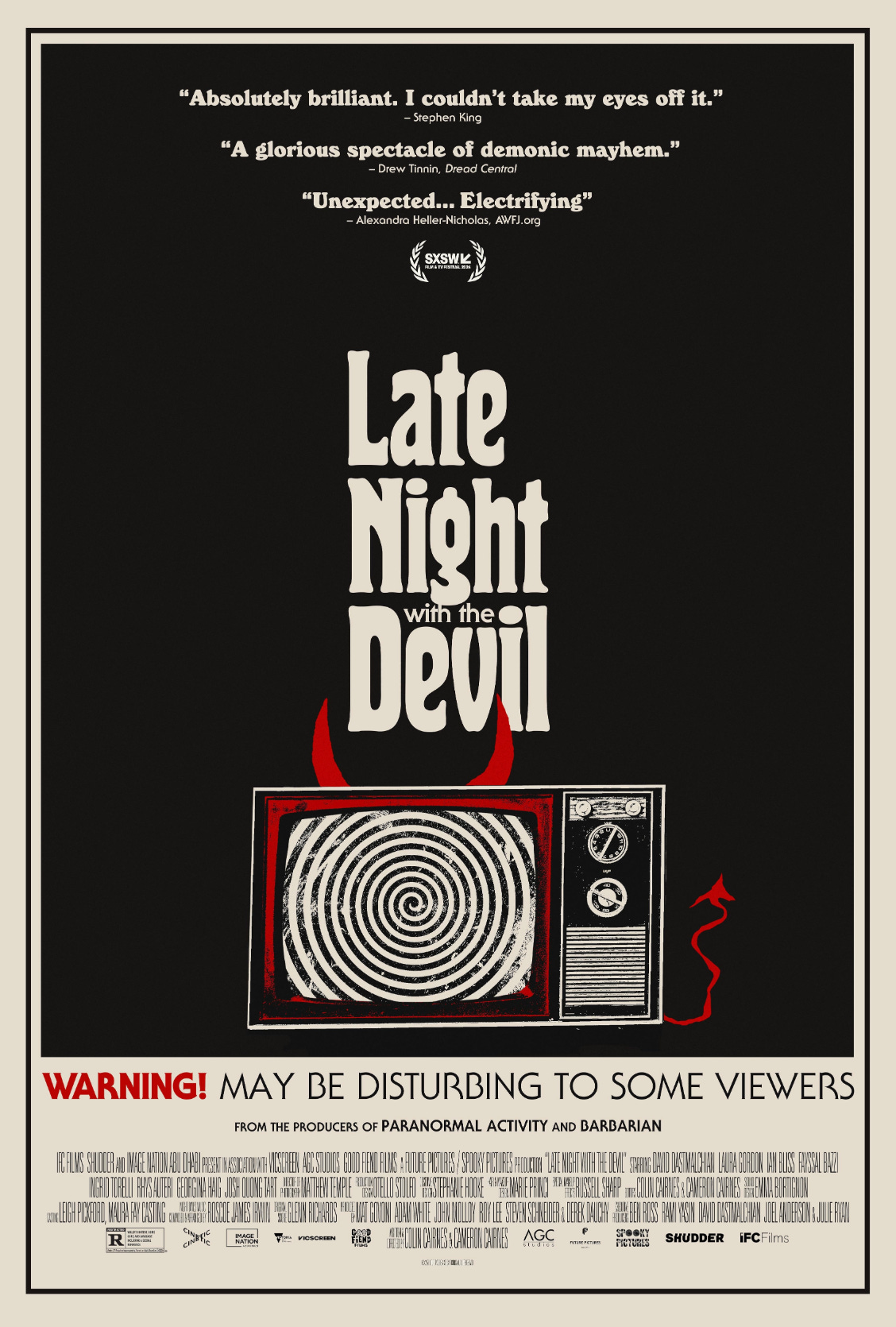
With his ratings faltering, a 1970s syndicated late-night TV show host brings on some supernatural guests for a Halloween episode that goes horrifyingly awry.
Initial Reception
After playing festivals like SXSW where it built positive buzz, Late Night with the Devil was unleashed in theaters in March 2024 (a somewhat surprising choice for a movie set at Halloween). With an estimated budget of only $1.5 million, the movie made $10 million in the U.S. and $15 million worldwide—a word-of-mouth indie hit. It premiered on Shudder a month later.
Key Moment
Eager to prove to viewers that what they’ve been seeing is all a ruse, magician and skeptic Carmichael Haig performs a demonstration on the power of hypnosis. Using the show’s Ed McMahon-like sidekick, Gus McConnell, as a volunteer, Carmichael hypnotizes everyone (including us?) to believe Gus has worms borrowing inside him. What happens next is one of the movie’s most terrifying moments.
Killer Line
“You needn’t worry about your TV show, I think you’re going to be very famous soon.”
Standout Player
Ingrid Torelli who plays Lilly, a 13-year-old survivor of a Satanic cult mass suicide. Lilly appears on the late-night show with parapsychologist Dr. June Ross-Mitchell, who is promoting her book about Lilly’s demonic possession. Despite being young, polite, and seemingly innocent, Lilly’s demeanor is immediately off-putting. The way she talks and the look in her eyes as she stares directly into the camera (and at us) take this movie from fun to frightening in an instance.
Achilles’ Heal
The last 10 minutes. Late Night with the Devil crescendos to a “holy shit” finale. It also has a very strong end cap. In between those two things there’s about 10 extra minutes where the movie tries to gel everything together. Thing is, it’s not really necessary. We can infer a lot of this. And it would be much more striking to go right from that powerful finale to that disturbing closing note.
Why It’s a Classic
To talk about what elevates Late Night with the Devil above the fray of 21st century horror movies, I’ve brought in a special guest who worked on the film. Here’s my interview with Mr. Wriggles, one of the minor deities that serves the demon Abraxas, who possesses Lilly in the movie (it gets its name because of the way it wiggles in and out of her mind)…
Hi, Mr. Wiggles. Thanks for taking the time to do this interview. I know you have a pretty busy schedule.
What is this? Where am I? What have you done to me?
We’re here to talk about Late Night with the Devil and what makes it such a great movie.
Oh, excellent. I thought you were another parapsychologist trying to “understand” me. Or, good forbid, a foolish priest trying to conduct an exorcism. Just the worst…
Anyway, Late Night with the Devil, what’s great about it? I think it’s the premise: What if a horror movie took place on a late-night talk show? It taps into what a strange phenomenon late-night talk shows are.
If you were around in the last few decades of the 20th century, late-night TV was this huge thing. I mean, it’s still a thing now—just look at how much Jimmy Kimmel gets under my fellow demon pal Trump’s skin—but back then people like David Letterman, Arsenio Hall, Conan O’Brien, and the godfather of them all, Johnny Carson, were major figures. For some reason, this landscape of TV primarily watched by the very old and the very young had an outsized importance in American culture.
How did it happen? How did Jay Leno and James Corden become notable TV personalities? Even Chevy Chase got a late-night show at one point. I can tell you from firsthand knowledge the only answer is the devil. Usually when things don’t make logical sense, that’s our work.
The movie takes place in 1977. Why is that important?
Along with being in that peak late-night TV period (Carson was in the middle of his 30-year run at this point), it’s important for a couple other reasons:
The 70s were just an inherently creepy fucking time. Of all the decades I’ve lived through, the aesthetic of that time period just really gives me chills, you know. Everything looks beat-down, grimy, a little weathered. And the movie really captures that. It’s filmed in a box-TV 4:3 aspect ratio (trapping you in) and the production design is full of those drab browns and dull oranges. It’s great.
The decade also calls to mind one of the all-time great horror movies—The Exorcist. With myself taking possession of Lilly, the young girl in the movie, you can’t help but think of that horror classic. So I think the two films are in conversation with each other in a fun way.
Other than yourself, who are some of your favorite characters/performances in the movie?
Well, I couldn’t do what I do without the people around me. They really lift me up.
One of the great things about the movie is, through the talk show format, we get a real sense of the characters we meet on screen. In a lot of horror movies, you just get a cardboard cutout and then they’re running around screaming. I always say, let’s dig into the soul a little before we terrorize it.
My favorite performances probably come from the people I worked with the closest, the ones whose hearts and minds I know oh so well:
Ingrid Torelli as Lilly (who you mentioned up top). Obviously, we worked VERY closely. She’s a great vessel, letting me cloak my devious scheming in her youthful innocence.
Ian Bliss as Carmichael Haig, the magician turned skeptic, who second guesses anything out of the norm that happens on the show (until he can’t anymore). Bliss plays a great smug asshole here. I like how he pulls the audience to his side so I get the chance to rip them back to mine.
Finally, there’s David Dastmalchian as Jack Delroy, the host of the fictional late-night talk show Night Owls. Dastmalchian, probably best known as Polka-Dot Man in The Suicide Squad, is the secret sauce that makes this whole thing work. He plays the jokes, banter, and reactions of a late-night host expertly, while also giving us glimpses of Delroy’s sadness, darkness, and (self?) deception. David is a dear friend. I helped him get the part of Whistling Marauder in Bird Box.
This is a low-budget movie, reportedly made for only $1-1.5 million. But it never really feels that low budget. How’d they pull that off?
Well, if you’re asking if I had something to do with it, I’ll never tell...
But seriously, there’s nothing more exciting than watching a small movie find creative ways to feel bigger than it actually is. While Late Night with the Devil essentially takes place all in one night and all in one place, it never feels constrained. The movie devises interesting (and cost-effective) ways to expand the universe.
For example, the movie begins with a 10-minute mini documentary that sets up the backstory of Jack Delroy and Night Owls. It talks about the show’s rise during a “time of unrest and mistrust, fear, and violence” in America, Jack’s professional and personal ups and downs, and the show’s current ratings difficulties. It’s a great way to set up the story that immediately grabs you.
There’s also another moment on the show where they share a clip produced by the Psi-Research Center giving us background on Lilly. Along with seeing still photographs of Lilly’s troubling past, there’s a moment where we hear an audio recording of the demon inside Lilly (played by yours truly) and all we see are spinning tape reels and audio gauge needles jumping. It’s so simple, yet I like to think it’s one of the scariest moments of the movie.
There are also some really cool “effects” in the movie, especially at the end.
All of these things meld together to make Late Night with the Devil feel like something bold, thrilling, and different; a discovery you’d come across on late night TV, enveloped by utter darkness other than that glowing box in front of you, unable to look away as it takes possession of your soul.
Great stuff, Mr. Wiggles. Thanks again for doing this.
Not a problem. Now I’ll just need your signature in blood...
Quick Takes
A whopping nine production, distributor, or PR company logos appear at the start of Late Night with the Devil. One after another, they just keep coming. It takes almost two minutes of screen time for them to finish.
Upon its release, the movie stirred up controversy for its use of AI to create several “We’ll be right back”-style title cards played during the fictional TV show’s commercial breaks. Directors Cameron and Colin Cairnes released a statement to Variety saying, “we experimented with AI for three still images which we edited further and ultimately appear as very brief interstitials in the film.” As Colin explained to Letterboxd it wasn’t about replacing people but trying to accomplish as much as they could with a small team and shoestring budget: “If we hadn’t made that choice with the A.I., which for us was seriously just trying to be resourceful and experimenting with this very new technology at the time, we would have just ended up repeating some other graphics that our team had done anyway. Our producers also happened to be our VFX artists and graphic designers. That’s how small and tight that our little family is.”
Late Night with the Devil directors Colin and Cameron Cairnes are brothers. Other examples of notable cinematic sibling behind the camera include Joel and Ethan Coen (Fargo, No Country for Old Men), Lana and Lilly Wachowski (The Matrix, Bound), Anthony and Joe Russo (Avengers: Infinity War, Avengers: Endgame), Peter and Bobby Farrelly (Dumb and Dumber, There’s Something About Mary), Albert and Allen Hughes (Menace II Society, Dead Presidents), Jean-Pierre and Luc Dardenne (Rosetta, The Promise), and Josh and Benny Safdie (Good Time, Uncut Gems).