

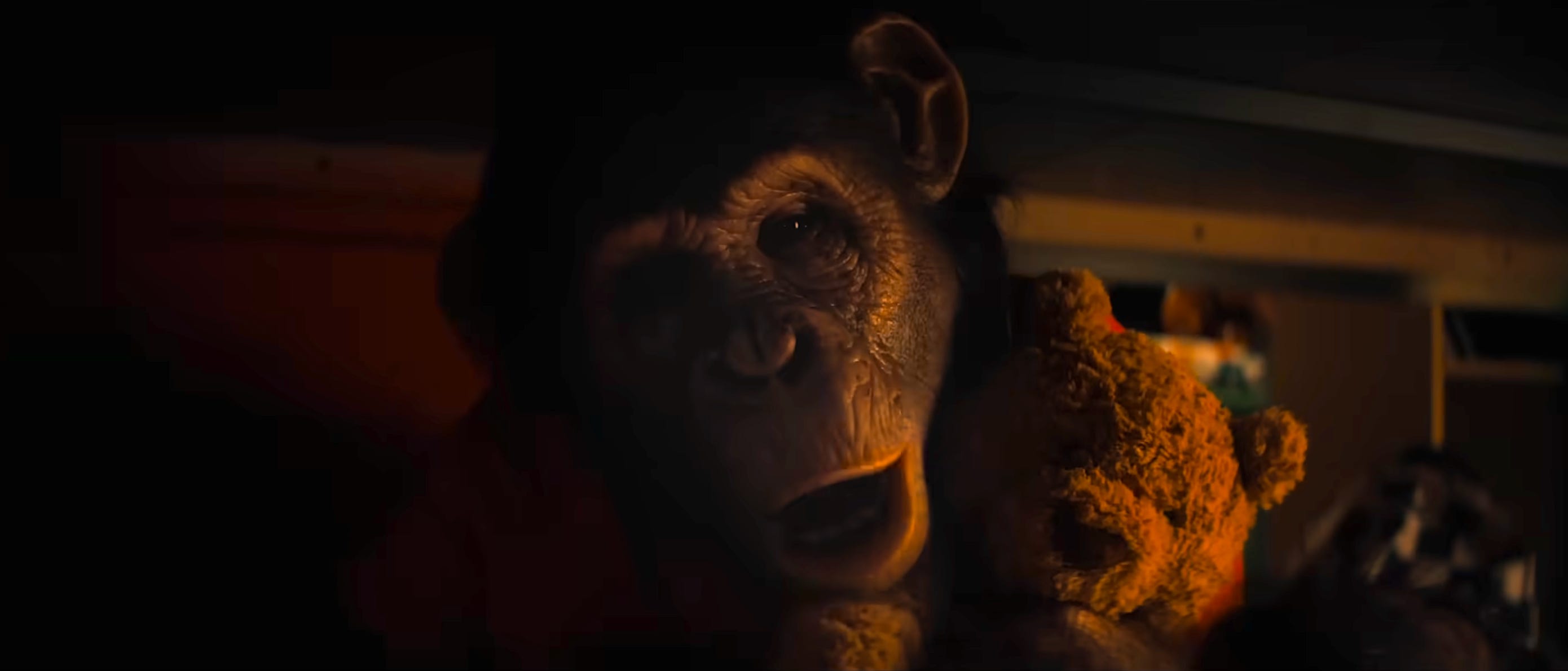
Primate tells the story of Lucy (Johnny Sequoyah), who returns from college with a group a friends to visit her dad and sister at their home in Hawaii. Unfortunately, she comes at a bad time—their pet chimp, Ben, just contracted rabies and he’s not feeling quite himself. Terror ensues.
Key Moment
Ben (the rabid “primate” of the title) finds a chatty, inebriated young man in a bedroom. He uses his powerful, pudgy digits to show the bro what he thinks of his conversation skills.
Killer Line
“Lucy. Bad.”
Standout Player
While all the actors are good, and the setting/location is memorable—it’s gotta be Ben. I couldn’t really tell if/when Ben was a real chimp, a CGI creation, or a man in a suit. His execution was seamless throughout. Never for a second did I doubt this was a real, living creature.
Big Picture
I was not prepared for this. I thought I would come to Primate mostly to laugh; to enjoy a sort of tongue-in-cheek horror experience with a few groan-inducing puns thrown in (“He’s gone bananas!”). This was not that experience. I didn’t laugh a lot at this movie. Which is not to say I didn’t enjoy myself (I enjoyed myself immensely). I just didn’t expect this movie to go as hard as it did. It goes VERY hard.
It’s been a while since I’ve seen a horror movie that actually triggered fear. This one did. That’s because instead of being clever or self aware, Primate focuses on the fundamentals: tension, peril, situations you can imagine yourself in, grisly kills, and making the audience feel unsafe. It doesn’t break new ground as a horror movie (there is nothing here we haven’t seen before), it just does the basics extremely well. It’s easy to forget how effective that can be.
Primate is also lean. This is a 90-minute movie in an age when 90-minute movies (even horror movies) are about as common as a chimp wearing a t-shirt. There’s not a lot of fat on this bone. We are introduced to our primary characters, learn just enough about them so they matter, and then the gears are set in motion. And those gears are turned and tightened with precision.
And, of course, there’s Ben. I was fully expecting Ben to be a source of comedy (whether intentional or unintentional). But he’s not that. He’s both sympathetic—there are moments when you truly feel bad for this animal—and terrifying. His strength, his stare, his physical movements and reactions make him a force to be reckoned with. It’s no exaggeration to say he’s up there with the best movie killers, reminiscent of both Jaws and Michael Myers. Ben even gives us a little nod to The Shining at one point.
As an animal, and one that’s not of sound mind, Ben doesn’t let anyone off the hook. There’s no reasoning with him. That combined with the sheer brute force he displays give him the scariest attribute of all—unpredictability. The filmmakers lean into this, using sound and editing to make us feel every attack and bodily injury. I winced multiple times during this movie, something I’m not prone to do. But I felt those smashes and gashes in a way I don’t in other movies.
All of that adds up to make Primate one of the most intense, gory, and legitimately scary mainstream horror movies to come out in a while. Don’t sleep on this chimp.
Quick Takes
The makers of the film used practical effects as much as possible for Ben. Key to that was movement specialist Miguel Torres Umba, who gives Ben a lot of his personality.
The cell phone has impacted horror probably more than any other genre. Along with the age-old dilemma of how to keep characters away from other people who could help, horror writers now also have to deal with the dilemma of how to keep people from just pulling out their phones and dialing for help. Primate has to do a decent amount of legwork in this arena.
You never really feel it while watching Primate, but this is essentially a one-location movie. It takes place at a remote, luxury cliffside house in Hawaii—providing an exotic, out-of-the-ordinary vibe. It’s a smart play that helps keep the budget low without ever making the production look cheap.
On a recent episode of the Movies and Marketing podcast, we created a Monkey Movie Mount Rushmore (“monkey” being a broad term used primarily for alliterative purposes that also encapsulated chimps, apes, gorillas, etc.) that included Every Which Way But Loose, Project X, and King Kong (2005). After seeing Primate, I might have to give it the fourth spot.