

This is the third post in the 90 from the 90s series, exploring underrated flicks from the great movie decade. To be eligible for this series, movies must have been released January 1, 1990 – December 31, 1999, and earned less than $20 million at the U.S. box office.
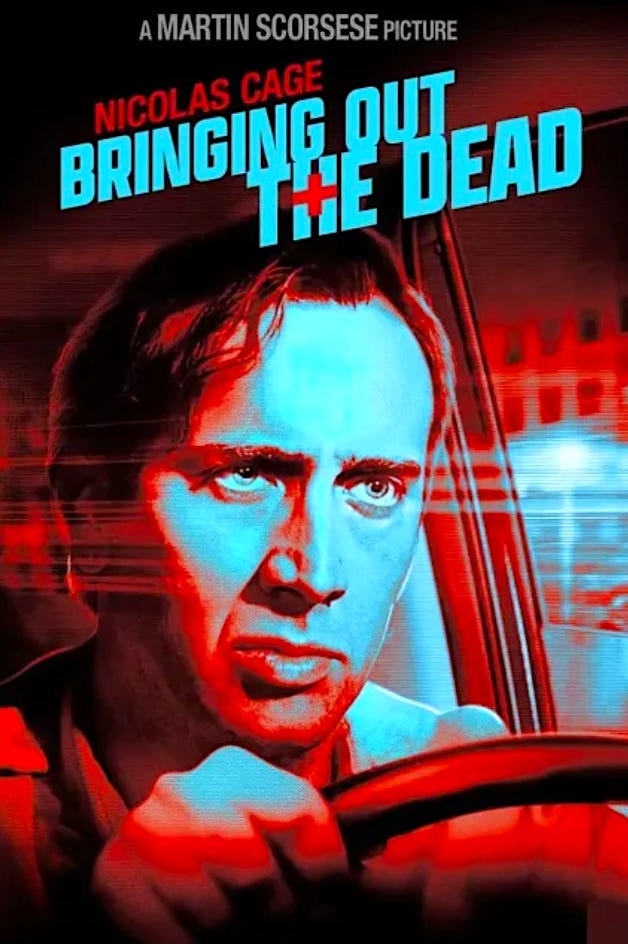
Director Martin Scorsese’s sixteenth feature film follows three nights in the life of New York City paramedic Frank Pierce (Nicolas Cage), who is unraveling during a prolonged stretch of patient fatalities.
Initial Reception
Released in theaters in late October of 1999 (one of the great movie years), Bringing Out the Dead received mostly positive reviews (Roger Ebert gave it four stars) but failed to find an audience. It opened in fourth behind The Best Man, the fifth weekend of Double Jeopardy, and the second weekend of Fight Club—and would go on to earn just $16 million on a reported $55 million budget (according to Box Office Mojo).
Key Moment
The manic ambulance ride. The Clash playing. Red siren spinning. Sped up film from the ambulance’s POV showing the NY city streets flying by in a blur. Cage at the wheel looking insane. Sizemore in the passenger city guzzling coffee. Both with red circles under their eyes. Sizemore staring at Cage as he grinds the gear shift, mesmerized at how Frank’s clearly lost his mind.
Killer Line
“Rise up, I. B. Bangin’! And start your life anew! Oh Lord, thank you, Lord!”
Standout Player
The brightest star of almost any Scorsese movie is Scorsese. The man just approaches material differently. The choices he makes here with lighting, cinematography, editing, and music (to name a few)—and the way he shifts and juggles tone—really put us inside Frank’s headspace. He also “appears” in the film as the disembodied voice in the ambulance, directing Frank to his next soul to save.
Achilles’ Heal
Marc Anthony as Noel, a mentally ill individual and frequent hospital visitor. This was one of Anthony’s first acting roles. It’s not that he’s terrible, but his look, demeanor, and character stick out like a sore thumb. There was no reason to cast a name in this role; it would have been far more effective if it was an unknown.
Why This Movie Still Matters
In the five-part documentary series Mr. Scorsese chronicling the director’s career, a meager two minutes are devoted to Bringing to the Dead—with Scorsese saying:
“I made a film called Bringing Out the Dead about EMS workers saving people at night in the streets. They’re like modern saints, wild angels of mercy, losing their minds from the suffering around them. And it was quite beautiful I thought. But I guess it just didn’t work in terms of box office.”
His comments about seeing Frank and his fellow ambulance drivers as saints/angels are telling as they inform a lot of the choices you see on screen—particularly the lighting. So much of Bringing Out the Dead is illuminated from above with bright white light. It’s visually striking and it makes perfect sense with the vision Scorsese has for the film, as though the heavens are open and looking down on them.
Also notable is the way the movie captures the feeling of sleep deprivation. Frank looks like he hasn’t slept in days (maybe years). He’s weary and completely burnt out. And the film conveys the haze, chaos, and dreamlike quality of going for an extended stretch without sleep (anyone who’s had kids can relate to this); the feeling that you’re floating through the world at a different speed/time than everyone around you.
The capstone here is the performances. Scorsese and Cage might feel like an odd pairing, but they actually make a lot of sense together. They’re both a little tuned up, operating on a cocaine level. As a result, we get one of Cage’s best, most dialed-in performances. Along with a low-key Patricia Arquette (creating a sad, recognizable character), we also get a murderer’s row of off-the-charts supporting performances from John Goodman, Ving Rhames, and Tom Sizemore—each giving Frank a different personality to play off.
While most of Scorsese’s filmography has been fairly acclaimed or reclaimed at this point, Bringing Out the Dead remains criminally underrated. Not only is it better than audiences thought upon its initial release (when it received a C- cinemascore), it’s up there with Scorsese’s best.
Quick Takes
Bringing Out the Dead came out at a cold point in Scorsese’s career. His previous film, 1997’s Kundun, made only $5.7 million at the box office. When this movie flopped too, he was on shaky ground once again after an early 90s comeback. Luckily, his next four movies (all starring Leonardo DiCaprio) did big business—Gangs of New York, The Aviator, The Departed, and Shutter Island.
This is the last of four collaborations between Scorsese and screenwriter Paul Schrader. The previous three were Taxi Driver (1976), Raging Bull (1980), and The Last Temptation of Christ (1988). Why did the collaboration end here? According to Schrader: “When I was doing Bringing Out the Dead, we both realized that the collaboration was over because there were now two directors in the room, and with Marty, there could only be one director in the room. He never approached me with anything else, and I never approached him with anything else.”
Here’s one to tuck in the back of your brain in case it comes up on Jeopardy some day: Bringing Out the Dead was the last North American LaserDisc release (on October 3, 2000). By this time, DVD had officially replaced the format—though LaserDisc players would continue to be produced until 2009.
I just finished Mr. Scorsese (which I adored) and it served as a painful reminder that I haven’t seen this film. I’ve always wanted to and your review and the doc is confirmation that I need to remedy that ASAP.
Scorsese and Cage should’ve worked together more! I thought the same thing when I first saw this film.